Written by Kelsie Pinkerton — founder of Pinkerton House and a former luxury wedding photographer who used consistent blogging to drive years of search traffic and client bookings.
Short Answer
Showit uses WordPress for blogging behind the scenes, which gives photographers the best of both worlds: beautiful front-end design and a powerful platform for publishing content that search engines understand. If long-term visibility matters to you (hint: it should!), choosing a template that’s intentionally built to support blogging can make a meaningful difference in how your site and business grow over time.
Why This Matters More Than People Realize
As photographers and creatives we are suckers for a pretty design, and understandably so. We’re wired to create beauty and discerning taste is our superpower!
But if your goal is to build a website that the right people find over and over (and I believe it should be), your blog will be doing much of the heavy lifting.
Search engines don’t index vibes.
They index content.
And blogging is one of the best ways to create that content in a way that compounds. Yes, still today.
A Little Real-World Perspective
In my own wedding photography business, I blogged every wedding I photographed. At the time, I wasn’t following some master SEO plan (really, I barely understood what I was doing) — I simply found blogging a way to control the way my work was first displayed. Curating and organizing the flow of my images was like telling the exact story I wanted to tell from a shoot, and while it was added work at the end of a project, the end result felt so satisfying to me. Plus, my clients (and fellow vendors) loved having their images blogged.
But over the years, those posts became one of the biggest drivers of traffic and the right bookings – the bookings that helped my photography business flourish.
Why?
- Dozens of high-quality images (exactly the kinds of shoots I wanted more of)
- Strategic file names getting indexed and referenced in Google
- Location and venue context
- Post titles tied to places I wanted to shoot (if you searched Four Seasons wedding in Scottsdale, you’d find me!)
- Links to other vendors and related weddings building all kinds of context & authority
And major bonus: each of these posts was perfect for Pinterest. My site was getting pinned, shared, and growing in reach on that platform before I even understood what it was.
Individually, each blog post felt small. Together, they built a body of work that search engines could understand — and surface at the right time to the right people — long after I’d published them.
In fact, I once booked a $9K wedding from a couple who found me through a seven-year-old post about their (fairly obscure) venue.
That’s the long game blogging supports.
How Showit + WordPress Actually Work Together
Showit handles your site’s design and visual layout.
WordPress powers the blog functionality underneath.
So you’ll write your blog posts within WordPress and use it’s built in tools to optimize for search. Then when you hit publish, the post takes on the visual layout and formatting you’ve created in Showit. You get the total creative freedom offered by Showit, and the blogging power of WordPress. This matters because WordPress is still one of the most robust publishing systems available. It’s designed to organize posts, create relationships between them, and make it easy for search engines to interpret what your content is about (aka – get your page seen by the right people).
You don’t have to stress about the technical side — but your template should make it easy to use that blogging power well.
What to Look for in a Template If Blogging Matters to You
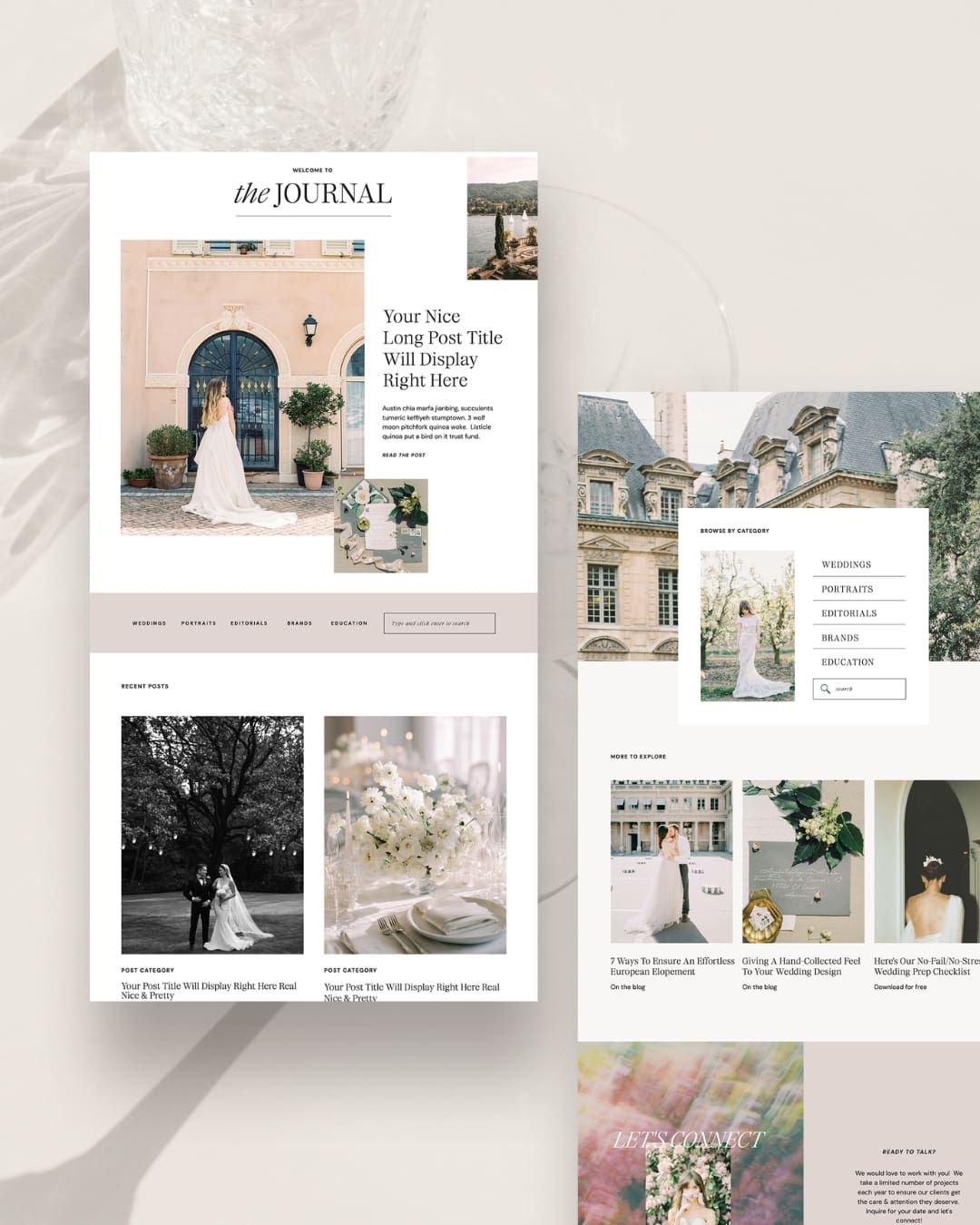
Not all templates treat the blog with the same intentionality as the rest of the website. If blogging is part of your growth strategy, when shopping for a website template, look for:
A Post Layout That Lets Your Work Breathe
Your images should feel like they’re being presented intentionally, not squeezed into a design that competes with them. A good blog layout gives your photos space while still making the story easy to read.
A Structure that Makes Storytelling Simple
You should be able to organize a post the same way you’d walk someone through a gallery — a clear beginning, clearly marked sections that guide them along, and a natural flow instead of one long scroll of content.
Built-In Ways to Connect One Post to Another
A strong template makes it simple to link related sessions, venues, or ideas so visitors (and search engines) can follow the thread of your work and find you a knowledgable, credible source. Look for sections like related reading, you might also like, some reader favorites, featured resources, continue exploring, etc.
Think of it like this: your goal is to make it simple for search engines and AI to understand and reference your content, and impossible for your dream client to resist going down the rabbit hole that is your blog 🐰. The blog pages in our Cloe Showit template were built with exactly this in mind.
Organization That Makes Sense Months — and Years — Later
Over time, you want your content to feel like a growing archive, not a haphazard pile. Categories, navigation, and layout should help people find things without digging.
A Design That Doesn’t Make Publishing Feel Like a Production
If every post requires a full page redesign, you won’t keep doing it. The right template makes blogging feel manageable — so you can focus on sharing the work, not formatting and re-formatting it.
Blogging Isn’t Dead — It’s Just Quieter and More Intentional
Today, blogging isn’t about posting constantly, keyword stuffing, or the strange, outdated SEO tactics that used to circulate. It’s about creating genuinely helpful, specific content that answers real questions your audience is already asking.
Each post becomes another entry point into your business. Over time, those entry points add up — and that accumulation is what builds real, lasting visibility and growth.
The function of your blog is very different from social media, where posts get a brief shining moment and then disappear into the scroll (no matter how beautiful they are). A well-optimized blog post keeps working quietly in the background — showing up in searches, helping the right people discover you months or even years later.
Social media can start the conversation. Your website and blog are what sustain it.
Pinkerton House Perspective
Over the years, I’ve watched photographers burn out doing all the things, just trying to stay visible. What has made the biggest difference in my own business (and so many others that I respect) is having a place where my work could grow and compound — where blog posts connected my work and expertise in a way search engines (and now AI-driven search) could actually understand and that made my business an obvious choice for my dream clients.
Today, that kind of structured, meaningful content matters more than ever. It helps your work surface when people are actively looking, not just for 12 hours after posting.
This is why I design templates where the blog is never an afterthought — it’s part of the foundation. Because a website built to grow with you over time is far more valuable than one that just launches well.
Key Takeaways
- Showit’s integration with WordPress gives photographers the best of both worlds and a powerful platform for long-term visibility.
- Blogging today continues to help search engines understand your work and expertise, which helps you get seen consistently over time.
- A template should make it easy to publish consistently — if it’s complicated you won’t do it.
- The goal isn’t to blog all the time. It’s to steadily build content that compounds.
FAQs
Does a photographer need to blog? Isn’t social media and a strong portfolio enough?
Blogging gives your work the kind of longevity and context that quick posts never can. While social content is out of sight, out of mind fast, blog posts stay quietly discoverable — especially when they’re tied to real sessions, locations, and questions your ideal clients are already searching for.
How does blogging work with Showit and WordPress?
Showit controls the design and visual layout of your site, while WordPress powers the blog behind the scenes. You get creative freedom in how your posts look, plus a robust, trusted publishing system built to organize content clearly so both visitors and search engines can understand it.
Do I need to understand SEO to make blogging worthwhile?
You do not need to become an SEO expert, but you do need a basic understanding of how your blog content is being interpreted by search engines. Blogging works best when it’s super clear what your post is about — using specific titles, real locations, thoughtful organization, and connections to related content on your site — rather than trying to “game” search with outdated tricks. The SEO tools inside of WordPress are really helpful when optimizing each post for search. If you want a deeper explanation of what that actually looks like in practice, I break it down in my article on what “SEO-friendly” really means.
Can blogging really help photographers book clients?
Yes — especially when posts are specific to your actual work and the kind of work you’re trying to attract. Venue features, locations, and vendors you worked with act like signposts in search. If you’re hoping to attract more micro-weddings on the Amalfi Coast, a blog with multiple posts showcasing those events — complete with strong imagery and thoughtful context — creates many entry points into your business for exactly those clients. Someone searching for that location or type of celebration can find you because you’ve intentionally documented the work in a way that search engines will surface over the long term. You can read more on what a website built to book clients looks like here.
Is blogging still relevant today?
Very much so. A thoughtful, strategic body of content helps search engines and AI understand what you do and who you serve so that it can repeatedly reference you to the right people. Unlike trends that come and go, well-structured blog posts continue to bring visibility over time.
What makes a Showit template “blog-ready”?
A blog-ready template makes it easy to publish and organize posts with clarity. It supports strong imagery, clear navigation, and natural connections between related content so your work feels like a growing archive rather than a collection of random posts. Remember, your goal is to make it simple for search engines and AI to understand and reference your content, and impossible for your dream client to resist going down the rabbit hole that is your blog 🐰.
Next Steps
If you’re on the hunt for a Showit template and know blogging will be part of your long-term growth, it’s definitely worth choosing a template designed to support that from day one.
Explore Pinkerton House templates
Learn more about Website in a Day
Kelsie Pinkerton is a Showit website designer and founder of Pinkerton House, with 20 years of experience in the luxury wedding industry.


